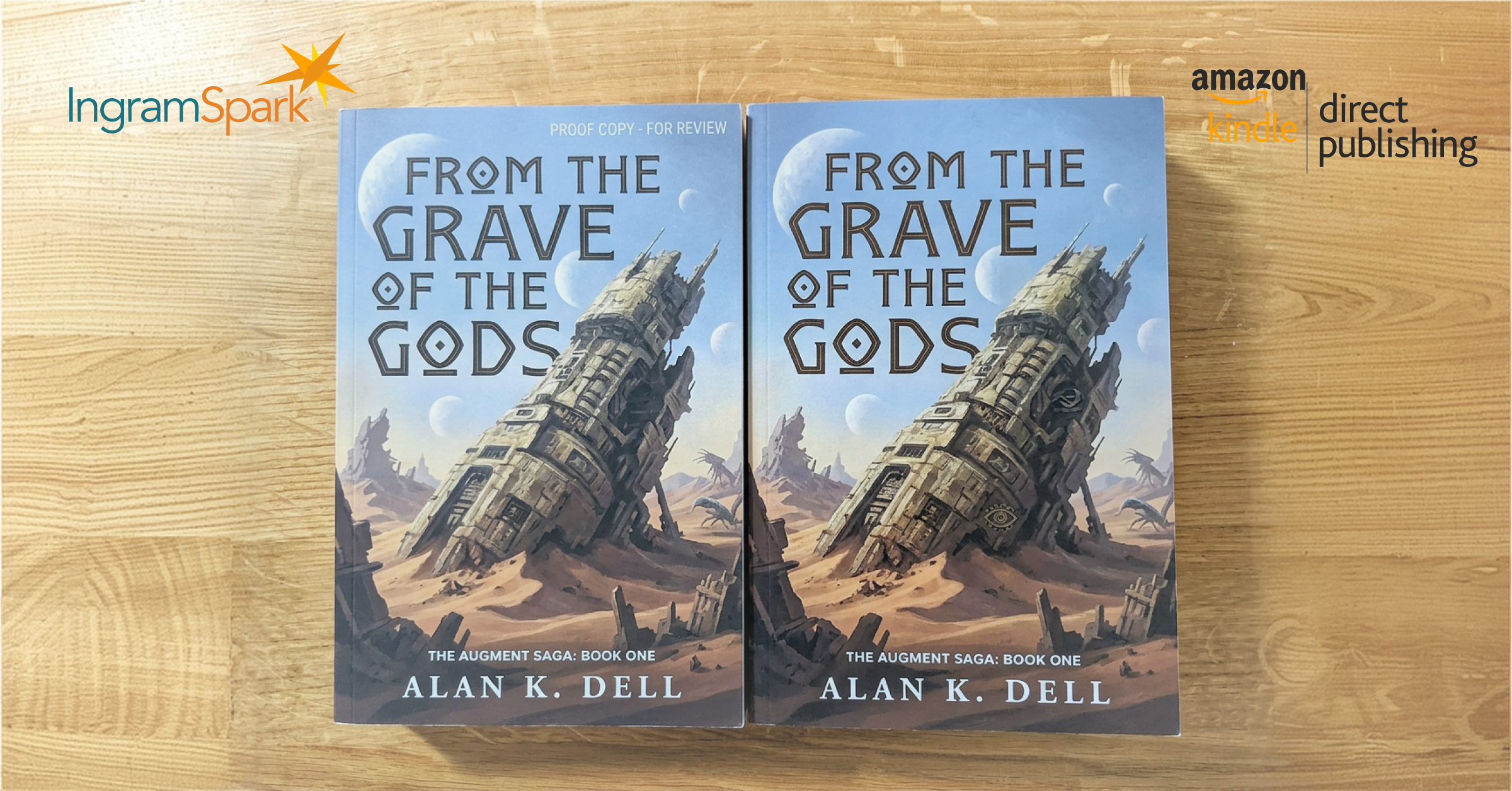
KDP vs IngramSpark is the decision that determines how far your book reaches once it’s written. Two platforms dominate self-publishing distribution: Amazon’s Kindle Direct Publishing (KDP) and IngramSpark, the self-publishing arm of Ingram Content Group. Most authors eventually hear that they should use both, and much of the advice on how to do that is incomplete. This guide compares royalties, fees, reach, returns and print quality with worked numbers, then shows how to set up both. Before this decision matters, the manuscript has to be finished; see our guide on how to finish writing a book.
Which Is Better: KDP or IngramSpark?
Neither wins the KDP vs IngramSpark contest for every book; KDP wins on simplicity and Amazon royalties, and IngramSpark wins on bookstore, library and school reach. Choose KDP if most of your readers buy on Amazon, you want zero upfront cost and you publish mainly eBooks and standard paperbacks. Choose IngramSpark if you want booksellers and librarians to be able to order your print book through Ingram, or you need colour interiors or finishes KDP doesn’t offer. Many authors use both: the eBook on KDP, and the print edition on KDP for Amazon and on IngramSpark for every other retailer, under the same ISBN. The table below sets the two platforms side by side.
Factor
KDP
IngramSpark
Main strength
Amazon sales, simplicity
Bookstores, libraries, schools
eBook royalty
70% at $2.99–$9.99, 35% otherwise
Set by retailer; paid after retailer’s share
Paperback royalty (Amazon.com)
60% of list price at $9.99+ (50% at $9.98 or less), minus printing cost
List price minus your chosen wholesale discount, print cost and market access fee
Expanded distribution
40% of list price minus printing cost
Core service
Wholesale discount and returns
Not set by you
You choose both; booksellers expect a trade discount
Hardcover
Available; see KDP’s hardcover printing cost page
Available, including case laminate and more specialist options
Upfront cost
Free
No title setup fee (dropped in 2023); since 2026, free revisions (from 1 February) and a 1.875% market access fee; check the current rate card
ISBN
Free KDP ISBN (Amazon only) or your own
Your own ISBN
Exclusivity
Only for eBooks in KDP Select
None
What KDP Does Well
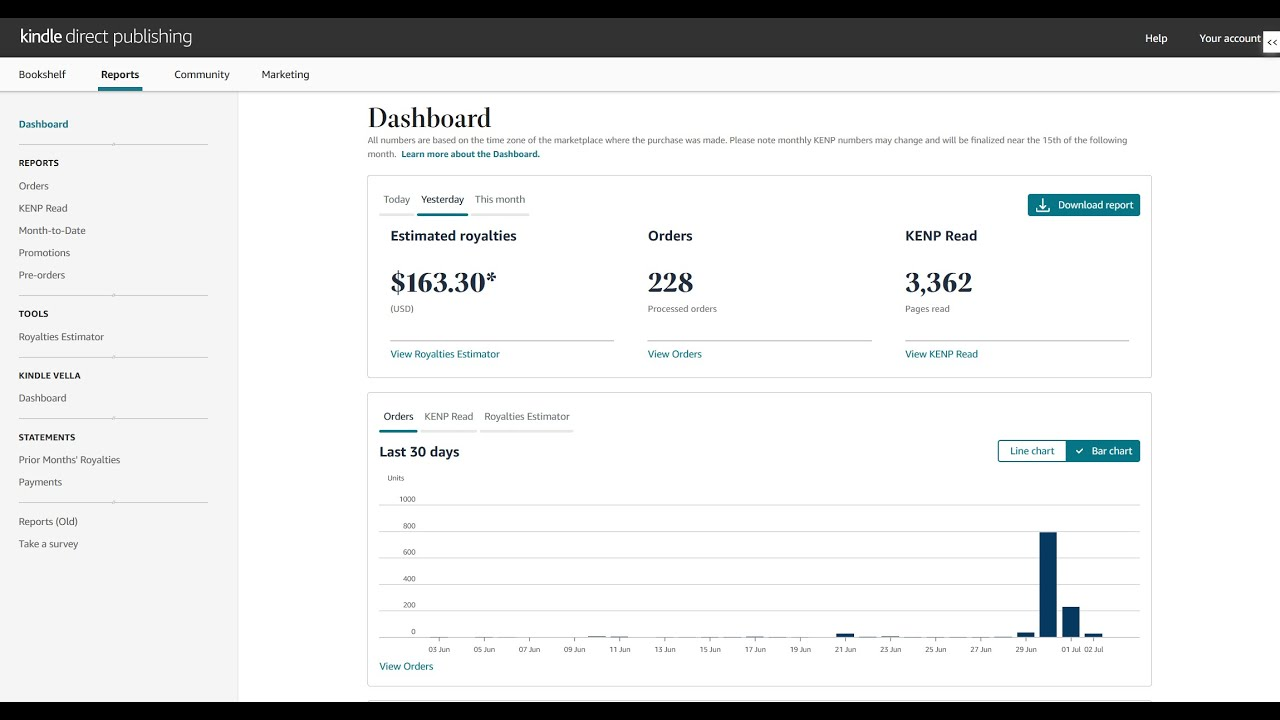
In the KDP vs IngramSpark comparison, KDP is Amazon’s own platform, and if your reader buys on Amazon it is the fastest, simplest way to reach them. Setup takes an afternoon, royalties are paid monthly, and the dashboard is well documented even for first-time authors.
KDP’s eBook royalties are strong: 70% on books priced between $2.99 and $9.99, 35% outside that range, according to Amazon’s official KDP eBook royalty terms. For paperbacks on Amazon.com, KDP’s paperback royalty documentation sets the rate at 60% for list prices of $9.99 or more (50% at $9.98 or less), minus printing cost. Expanded Distribution pays 40% of list price minus printing cost.
Printing cost depends on page count and ink. For a US black-ink paperback of 110 or more pages, KDP’s printing cost page lists $1.00 fixed plus $0.012 per page; shorter books of 24 to 110 pages cost a flat $2.30.
Worked example: a 200-page black-ink paperback listed at $14.99 on Amazon.com. Printing cost is $1.00 + (200 × $0.012) = $3.40. Royalty is (60% × $14.99) − $3.40 = $5.59 per copy. Sold through Expanded Distribution, the same book earns (40% × $14.99) − $3.40 = $2.60. This assumes current US rates and black ink on a standard trim; check the pages above before you price.
KDP Select, Amazon’s exclusivity programme, gives your eBook access to Kindle Unlimited and promotional tools. As Amazon’s own KDP Select terms state, enrolling commits your eBook to Amazon only: no Apple Books, no Kobo, no direct sales. Enrol only if your analytics show your readers are on Kindle Unlimited.
What IngramSpark Does Well
IngramSpark gives your print book access to the retailers, libraries and schools that order through Ingram. Ingram Content Group describes itself as the world’s largest distributor of physical and digital content, reaching more than 40,000 bookstores, libraries, and online retailers, according to its distribution page. A bookseller who wants your title usually orders it through an existing Ingram account, so being in that catalogue matters.
KDP’s Expanded Distribution is available, but its 40% royalty rate and terms leave little room for a bookstore to stock the book. IngramSpark lets you choose your own wholesale discount and returns setting, which is what booksellers expect. This is where KDP vs IngramSpark differs most for print.
IngramSpark also handles colour interiors, hardcovers with case-laminate finishes and some specialist formats. In 2026 IngramSpark changed its pricing: its help centre notice on print cost and market access fee changes sets a 1.875% market access fee on books enabled for distribution, with free file revisions from 1 February 2026. Your compensation is list price, minus the wholesale discount you choose, minus print cost, minus that fee. Always confirm the current rate card before pricing, as these terms have changed more than once.
How Do Wholesale Discounts and Returns Work on IngramSpark?
On IngramSpark you set a wholesale discount, typically between 40% and 55% of list price, and decide whether to accept returns; both settings change what you earn per copy. A higher discount and returns enabled make your book easier for a bookstore to stock, but a returned copy is a cost to you, so authors focused on online sales often pick a lower discount without returns.
Worked example: the same 200-page, $14.99 paperback. Assume an IngramSpark print cost of $3.90 (an illustrative figure; use IngramSpark’s own calculator for your trim and paper). At a 40% discount, you earn $14.99 − $6.00 − $3.90 − $0.28 (the 1.875% fee on list price) = $4.81 per copy. At a 55% discount, you earn $14.99 − $8.24 − $3.90 − $0.28 = $2.57. Compare that with $5.59 on KDP’s direct Amazon listing: the lower per-copy figure is the price of access to bookstores and libraries.
KDP vs IngramSpark: What’s the Right Choice for Most Authors?
For most authors, the right choice isn’t either/or; it’s both, split by sales channel. Publish the eBook through Amazon Kindle Direct Publishing, where strong royalties and the largest retail audience make it the clear default. Publish the paperback on KDP for Amazon, where it earns the 60% direct royalty, and on IngramSpark for bookstores, libraries and other retailers, with IngramSpark’s Amazon channel switched off so the two listings don’t overlap. This KDP vs IngramSpark split captures KDP’s simplicity and royalties on Amazon and Ingram’s wholesale reach for everything else.
eBook: KDP. If you want Apple Books and Kobo sales, stay out of Select and add a distributor such as Draft2Digital.
Paperback: KDP for Amazon, with KDP Expanded Distribution left off. IngramSpark for bookstores and libraries, with the Amazon channel switched off in its distribution settings. Use the same ISBN on both.
Hardcover: IngramSpark if you need finishes or reach beyond Amazon; KDP also offers hardcovers for authors who only need Amazon.
If you publish a single title on a tight budget and your readers buy on Amazon, KDP alone is a reasonable choice. If you would rather hand the setup to specialists, see our book publishing services.
How Do You Publish on Both KDP and IngramSpark?
Publish on both by using one ISBN per format, setting up KDP first, then adding IngramSpark with distribution settings that avoid overlap. Follow these steps:
Buy your own ISBNs, one for each format (eBook, paperback, hardcover).
Publish the eBook on KDP and decide on Select or wide distribution.
Create the IngramSpark title with the same ISBN as your print edition, choose your wholesale discount and returns setting, and switch off the Amazon sales channel.
Upload the print edition on KDP with that same ISBN for the direct Amazon listing, and leave KDP Expanded Distribution off.
Order proof copies from the printer and check trim, spine and colour before approving.
Print Quality: Is There a Real Difference?
For standard trade paperbacks (6×9 inches, B&W interior), both platforms produce comparable quality. In KDP vs IngramSpark print quality, the gap is negligible for standard trims but widens for anything custom. Paper brightness varies slightly, and spine printing can be marginally sharper on one platform in any given print run, so order a proof from each.
For colour interiors, children’s books and detailed illustrations, IngramSpark’s printing network, including Lightning Source, Ingram’s print-on-demand production arm, tends to be preferred for consistent colour. This matters for a children’s picture book or a coffee-table title. It matters less for a business memoir.
Should You Use KDP’s Free ISBN, or Buy Your Own?
Buy your own ISBN rather than using KDP’s free one, whichever side of KDP vs IngramSpark you favour. KDP’s free ISBN lists Amazon as the publisher of record and can’t be carried to IngramSpark, which requires your own, so it limits where that edition can be distributed and looks unprofessional in a library catalogue. ISBNs follow ISO 2108 and are administered by one national agency per country: Bowker in the US, Nielsen in the UK. Bowker, the official US ISBN agency, prices a single ISBN at $125 and a block of ten at $295. If you are publishing more than one book, or more than one format, buy ten. See also our guide on protecting your book draft from copyright theft before you publish.
Frequently Asked Questions
Can I use KDP and IngramSpark for the same book?
Yes, for print. Use your own ISBN on both, leave KDP Expanded Distribution off, and switch off the Amazon channel in IngramSpark so each platform covers its own retailers. The exception is eBooks enrolled in KDP Select, which must be exclusive to Amazon.
Does IngramSpark charge a setup fee?
No. IngramSpark dropped title setup fees in 2023. Since 2026 revisions have been free (from 1 February), and it charges a 1.875% market access fee plus print costs. Confirm the current rate card in your account before publishing.
Which pays more per copy?
In a KDP vs IngramSpark royalty comparison, a KDP paperback usually pays more on Amazon because there is no wholesale discount. IngramSpark pays less per copy but unlocks bookstores and libraries.
Can I use my free KDP ISBN on IngramSpark?
No. KDP’s free ISBN is assigned to Amazon’s imprint and is for KDP use only. Buy your own ISBN if you want the same number on both platforms.
Does KDP offer hardcovers?
Yes. KDP prints hardcovers in the US; check its hardcover printing cost page for the current fixed and per-page charges before pricing. IngramSpark offers more finish options and wider distribution for hardcovers.
Ready to format and publish your book?
We handle KDP and IngramSpark setup as part of our full-service publishing packages. Fixed price, no surprises.
Get a publishing proposal