Missing the right children’s book word counts for the age group is one of the quickest ways for a manuscript to look unready before anyone has judged the story. A picture book that runs 1,400 words or a middle-grade novel of 12,000 words signals the wrong format, however good the idea is.
Length in children’s publishing is not an arbitrary gate. It follows how children at different stages listen, read and look at pictures. This 2026 guide to children’s book word counts sets out the ranges, shows how they work on a real page layout, compares them with well-known titles, and explains when it makes sense to break them.
What are the right children’s book word counts by age group?
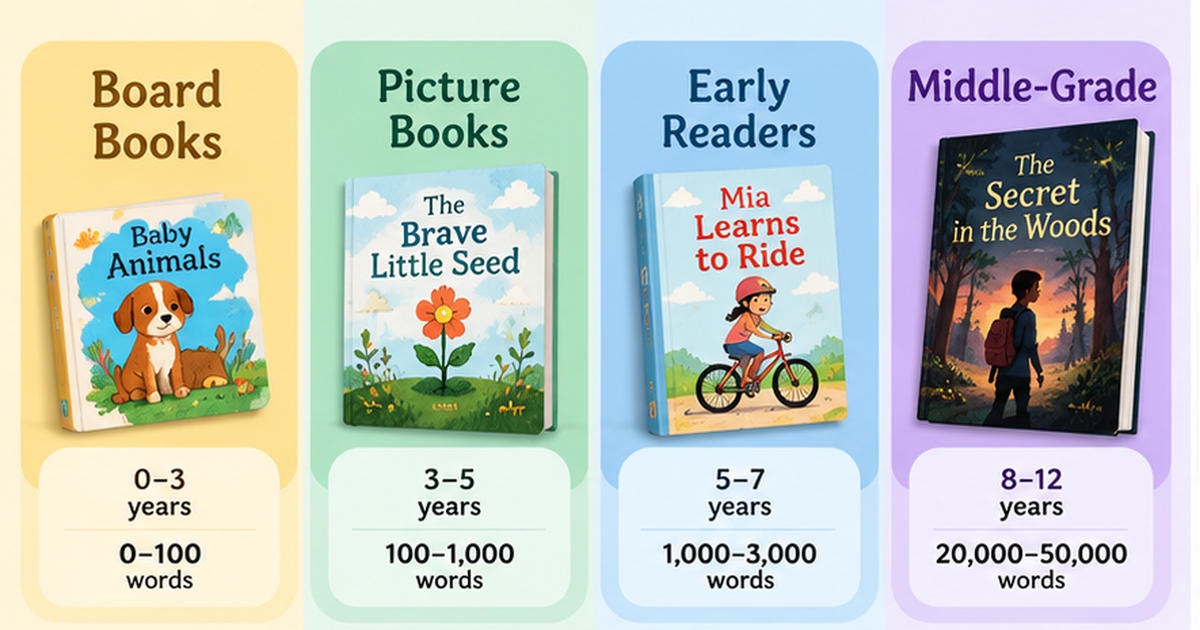
The right children’s book word counts depend on the format: board books run 0–200 words (most under 50), picture books 500–800, early chapter books 4,000–10,000, middle-grade 20,000–55,000, and young adult roughly 55,000–80,000. These ranges reflect how long a child at each age can listen or read before attention drops. Sources differ at the edges, so treat each range as a norm rather than a rule. Staying inside the range for your category is the simplest way to avoid an early rejection and to keep illustration and printing costs workable for self-published titles on Amazon KDP.
Word count ranges at a glance
Format
Age
Typical word count
Board book
0–3
0–200
Picture book
3–8
500–800
Rhyming picture book
3–8
200–500
Nonfiction picture book
5–8
800–1,200
Levelled reader (Levels 1–2)
5–7
100–500
Levelled reader (Levels 3–4)
5–8
500–3,500
Early chapter book
5–8
4,000–10,000
Middle-grade
8–12
20,000–55,000
Young adult
12–18
55,000–80,000
Middle-grade and young adult ranges follow Writer’s Digest’s word count guide, which also suggests about 500–600 words for a standard 32-page picture book and warns that editors may hesitate near 1,000. Picture-book age bands, rhyming and nonfiction ranges come from the Bookfox breakdown. Individual agents and publishers set their own limits, so always check submission guidelines.
Why do different guides give different numbers?
Guides differ because each draws the age bands and format lines in a slightly different place. The Write for Kids guide puts board books at 0–100 words, picture books at 1,000 or fewer (300–800 is common), early readers at about 500–2,000, chapter books at 5,000–15,000 and middle-grade at 30,000–60,000. Jared Dees gives 5,000–15,000 for chapter books and 30,000–60,000 for middle-grade. The pattern is the same everywhere: shorter for younger readers, with a soft ceiling rather than a hard wall.
Board books (ages 0–3): 0–200 words
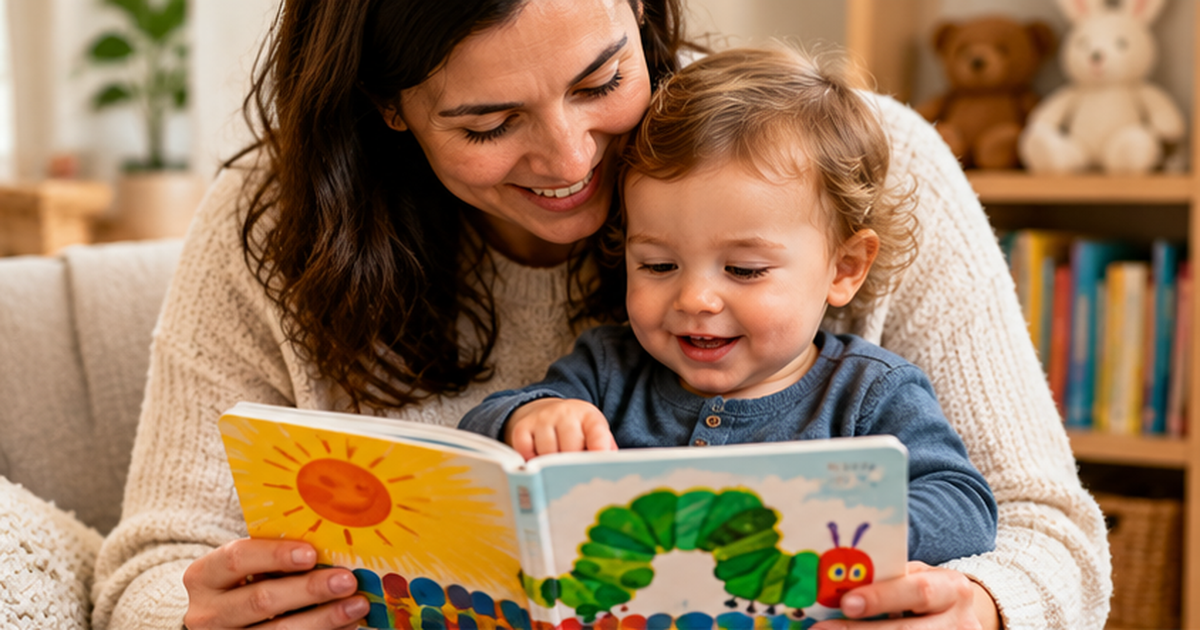
Board books are not short picture books. They are a distinct format with a distinct logic. The child is a pre-reader, the page is consumed mainly through the image, and the text is a verbal accompaniment that a parent reads aloud to a child who is responding to the sound of an adult voice.
That means the text needs to be speakable before it needs to be meaningful. Rhythm, repetition and simple rhyme perform better than complex narrative. The most successful board books are often the barest: a single noun on each page, a repeated phrase, a pattern a very young child can begin to anticipate.
Two hundred words is a ceiling, not a target, and it is the tightest of all children’s book word counts. Bookfox puts typical board books under 50 words, and estimates “Goodnight Moon” at about 130 words and “Brown Bear, Brown Bear, What Do You See?” at about 200. When you find yourself writing more, ask what you are compensating for in an illustration that is missing.
Picture books (ages 3–8): 500–800 words
The picture book word count is the most commonly broken of all children’s book word counts, and it almost always goes the same way: too many words. Authors who love their story want to give children all of it. The result is a manuscript of 1,500 words that costs more to illustrate and tires its audience halfway through a read-aloud.
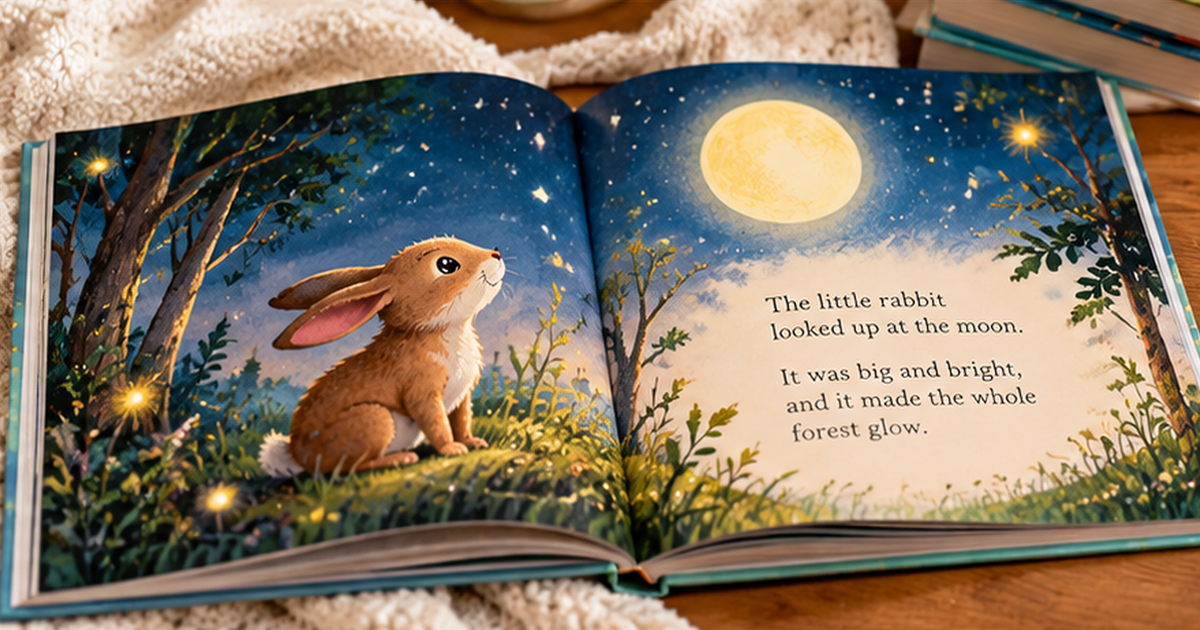
Picture books are read aloud, and that governs everything. Bookfox breaks the range down by age: roughly 100–300 words for ages 2–4, 300–700 for ages 4–6, and 700–1,000 for ages 6–8. The industry standard is a 32-page book printed in 8-page signatures, and a typical layout leaves about 28 pages, or 14 spreads, for the story once title pages and other front matter are set aside.
Worked example: a 600-word picture book
Take a 600-word manuscript on 14 spreads. That is about 43 words per spread, enough for a few short sentences beside a full illustration. At a read-aloud pace of roughly 120–150 words a minute, the text takes about four to five minutes, plus time for children to study each picture. Stretch the same layout to 1,400 words and you have about 100 words per spread, which crowds the art and invites the adult reader to skip lines. These figures assume 14 story spreads and an average read-aloud pace; your layout may differ.
How long are famous picture books?
Bookfox’s estimates show that classics vary widely, and that many sit well below 1,000 words. Established authors with a track record can go longer; for a first book, 500–800 words remains the safer target, and rhyming stories usually come in lower, at 200–500.
Title
Approx. words
Goodnight Moon
130
Brown Bear, Brown Bear, What Do You See?
200
The Very Hungry Caterpillar
220
Where the Wild Things Are
330
Chicka Chicka Boom Boom
400
Don’t Let the Pigeon Drive the Bus!
700
The Tale of Peter Rabbit
1,000
Make Way for Ducklings
1,200
These are Bookfox’s approximate counts, not official figures from the publishers.
Early readers and chapter books (ages 5–8)
This is the most complicated range because it contains several sub-formats, each with its own children’s book word counts:
Levelled readers (Levels 1–2): 100–500 words. Controlled vocabulary, short sentences, one clause per sentence. These are learning-to-read books, so the constraints come from reading development rather than editorial preference.
Levelled readers (Levels 3–4): 500–3,500 words. More complex sentence structures, two or three plot threads, still significant illustration.
Early chapter books: 4,000–10,000 words. Short chapters (800–1,500 words each), simple but not patronising vocabulary, and an illustration every few pages. The “Magic Tree House” series is the usual format benchmark; Jared Dees puts its books at about 5,000 words, with “Nate the Great” near 1,600 and “Mercy Watson to the Rescue” near 1,900.
Levelling systems vary by publisher, so a “Level 2” in one series may not match a “Level 2” in another. If you are writing for a specific imprint’s reader programme, its own guidelines outrank any general range.
Middle-grade (ages 8–12): 20,000–55,000 words
Middle-grade is the range where children’s book word counts matter least as a hard constraint and most as a signal of how developed the story is. A 12,000-word “middle-grade” manuscript is either a chapter book that needs repositioning or a first draft that has not found its full scope.
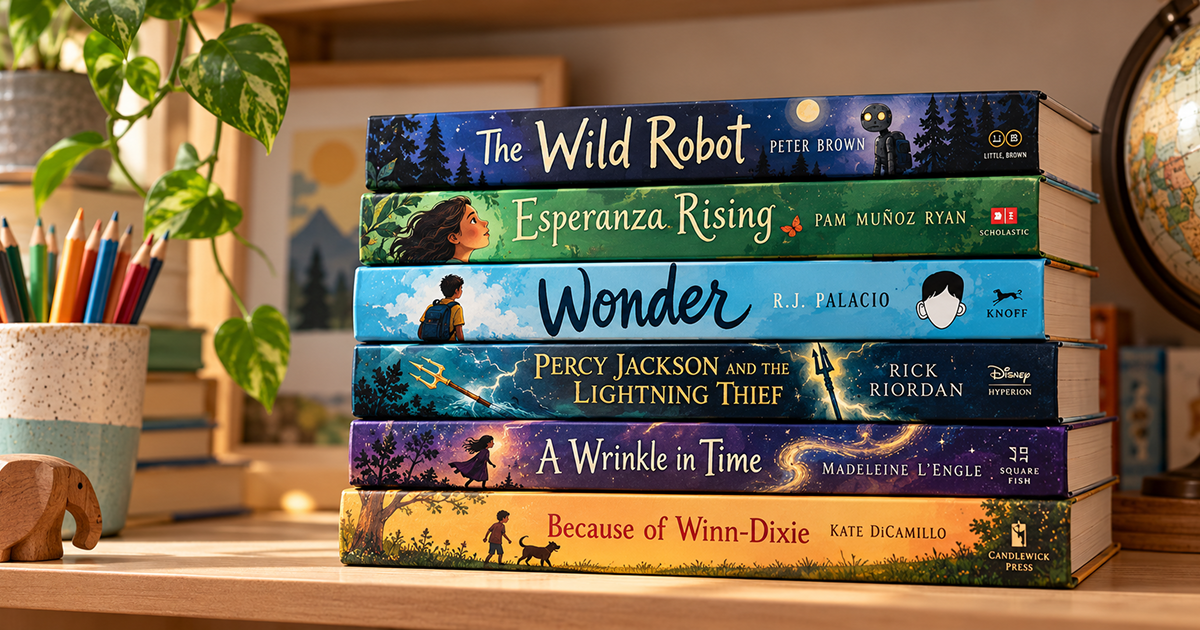
Writer’s Digest gives 20,000–55,000 words as the standard span: about 20,000–35,000 for simpler books, and 40,000–55,000 for upper middle-grade aimed at around 12-year-olds. Jared Dees’s title estimates show the spread: “Charlotte’s Web” at about 32,000 words, “The Wild Robot” at 35,000, “Hatchet” at 42,000, “Wonder” at 73,000 and “The Lightning Thief” at 87,000. For self-publishing, the top of the range is often counterproductive: longer books cost more to produce and are harder to price on Amazon. Fantasy middle-grade regularly runs to 70,000–80,000 words and still succeeds, but outside fantasy and some adventure stories, 55,000 is a practical ceiling.
Young adult (ages 12–18): about 55,000–80,000 words
Young adult fiction usually runs 55,000 to 79,999 words, the range Writer’s Digest recommends. Manuscripts below 55,000 can work, but not much below 47,000, and going into the 80,000s is risky unless the genre justifies it, as with science fiction or fantasy world-building.
YA sits at the top end of children’s book word counts, and genre decides where in the range a manuscript should land. Contemporary, romance and thriller YA tend to sit in the lower half, where pace carries the story, while fantasy and science fiction lean toward the ceiling to make room for world-building. Length also drives production cost for self-published authors. At roughly 250–300 words per page on a 5.5 × 8.5 inch trim, a 70,000-word novel prints at about 230–280 pages, and every extra page raises the printing cost Amazon KDP deducts from each paperback sale. These page figures are estimates; your typeface, margins and chapter openings will change them.
How do you check and trim your manuscript to the right length?
Check your manuscript against your age category first, then trim in stages, cutting whole ideas before individual words. Follow these steps:
Decide the exact format and age band before you count, using the table above.
Count only the story text. Leave out title pages, copyright, illustration notes and author notes, and any book dedication you plan to add. Microsoft Word, Google Docs (Tools > Word count) and Scrivener all give an instant total once that material is removed.
Compare your count with the range. If you are more than 10% over, the problem is usually structure, not wording.
Cut scenes and repeated beats first, then descriptions that an illustration can carry.
Read the text aloud against a timer and mark every line where you stumble or an adult would skip.
Split the text across spreads (picture books) or chapters (longer books) and check that no page is overloaded.
Do not cut only to hit a number. If the count is far outside the norm, first ask whether you have chosen the wrong age group.
Why breaking children’s book word counts rarely works in your favour
Breaking children’s book word counts rarely helps because the limits describe what a three-year-old, an eight-year-old or a twelve-year-old can take in. Every author who writes a 1,400-word picture book believes the story justifies the length. The better question is whether the reader has the capacity to be served by it.
The ranges are not publisher gatekeeping alone; they reflect long observation of what children at each stage can engage with. They can be broken, but only with a clear structural reason and a clear understanding of what you are asking of your reader.
Children’s book word count FAQ
How many words should a children’s picture book have?
Aim for 500–800 words for a standard fiction picture book. Rhyming books often sit at 200–500 words, and nonfiction picture books can reach 800–1,200.
How long are typical books for children aged 9 to 12?
Middle-grade novels for ages 8–12 typically run 20,000–55,000 words, with upper middle-grade at the higher end of that span.
What is the upper middle-grade word count?
Upper middle-grade, aimed at readers around 12, usually runs 40,000–55,000 words, according to Writer’s Digest. Fantasy can stretch beyond that.
Does word count include illustrations or page numbers?
No. Count only the story text that a reader will read, not front matter, captions you will not publish or production notes.
Does the word count include the title or illustration notes?
Usually not. Most guides, including Write for Kids, count the story text only. Follow any specific instruction from the agent or publisher.
Can a first-time author go over the recommended range?
It is possible, but harder. First-time authors are generally advised to stay under 1,000 words for picture books, because established authors are given more latitude.
Are board books the same length as picture books?
No. Board books are much shorter, usually well under 200 words, because the youngest listeners respond to rhythm and images rather than plot.
Do series follow the same length guidelines?
Usually yes. Keeping each title in a series at a similar length gives readers a consistent experience.
Are word counts different for ebooks?
No. Children’s book word counts stay the same for ebooks because the reader’s needs are the same. Format affects layout, which is why fixed-layout design matters for illustrated titles, and why how fast readers judge a book cover matters as much as the text inside.
Working on a children’s book?
Our children’s book writing team handles board books through middle-grade and keeps your children’s book word counts on target, with illustration coordination and KDP publishing. See how the work runs on our process page.
Children’s book services