If you’re a business owner weighing whether to write your own lead-generating ebook, the first question is practical: how long to write an ebook without hiring a ghostwriter? Most self-written nonfiction ebooks take 120 to 180 hours of total work, spread across outlining, drafting, editing, and formatting. That is roughly 8 to 16 weeks if you can commit 10 to 15 hours a week. Below is a stage-by-stage breakdown, a worked example, and answers to the questions people ask most, so you can plan a realistic timeline instead of guessing.
How Long to Write an Ebook? A Straight Answer
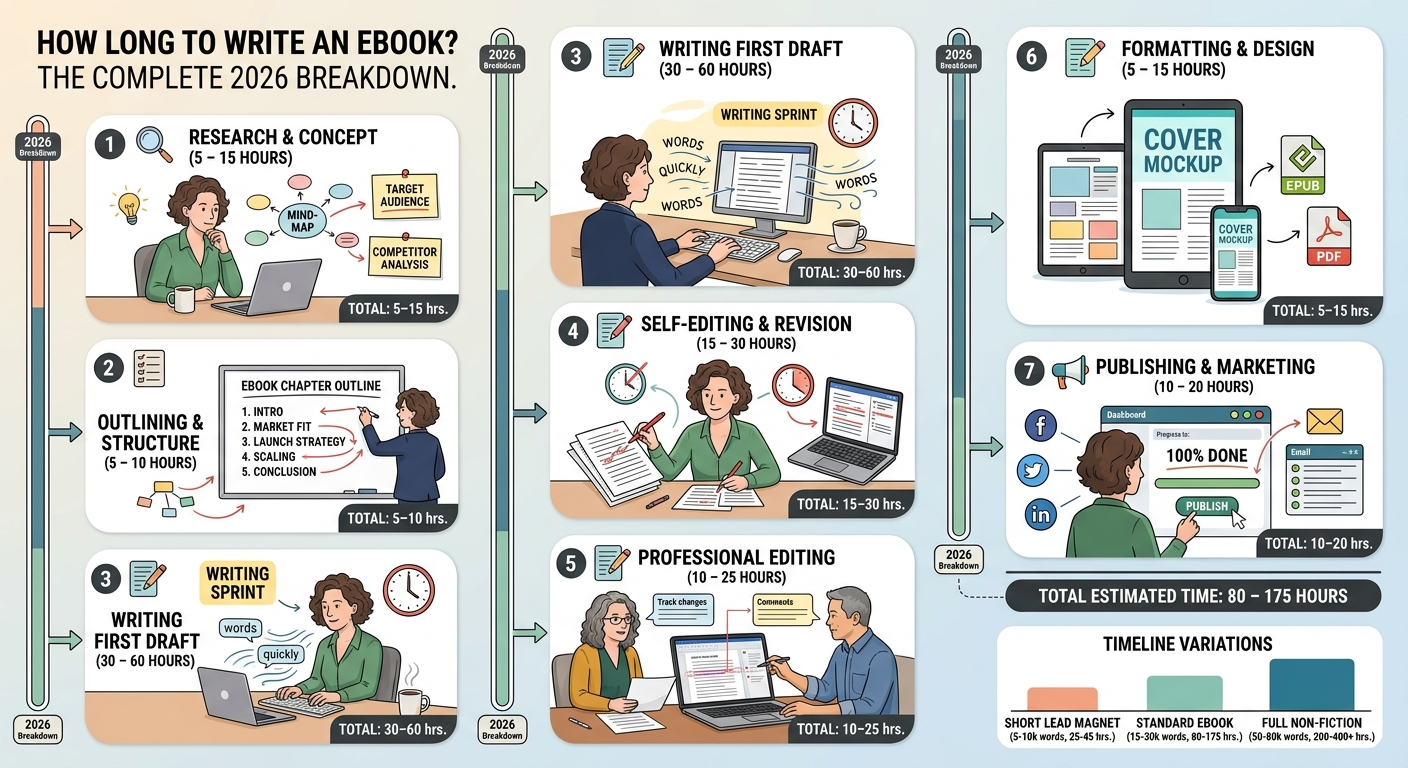
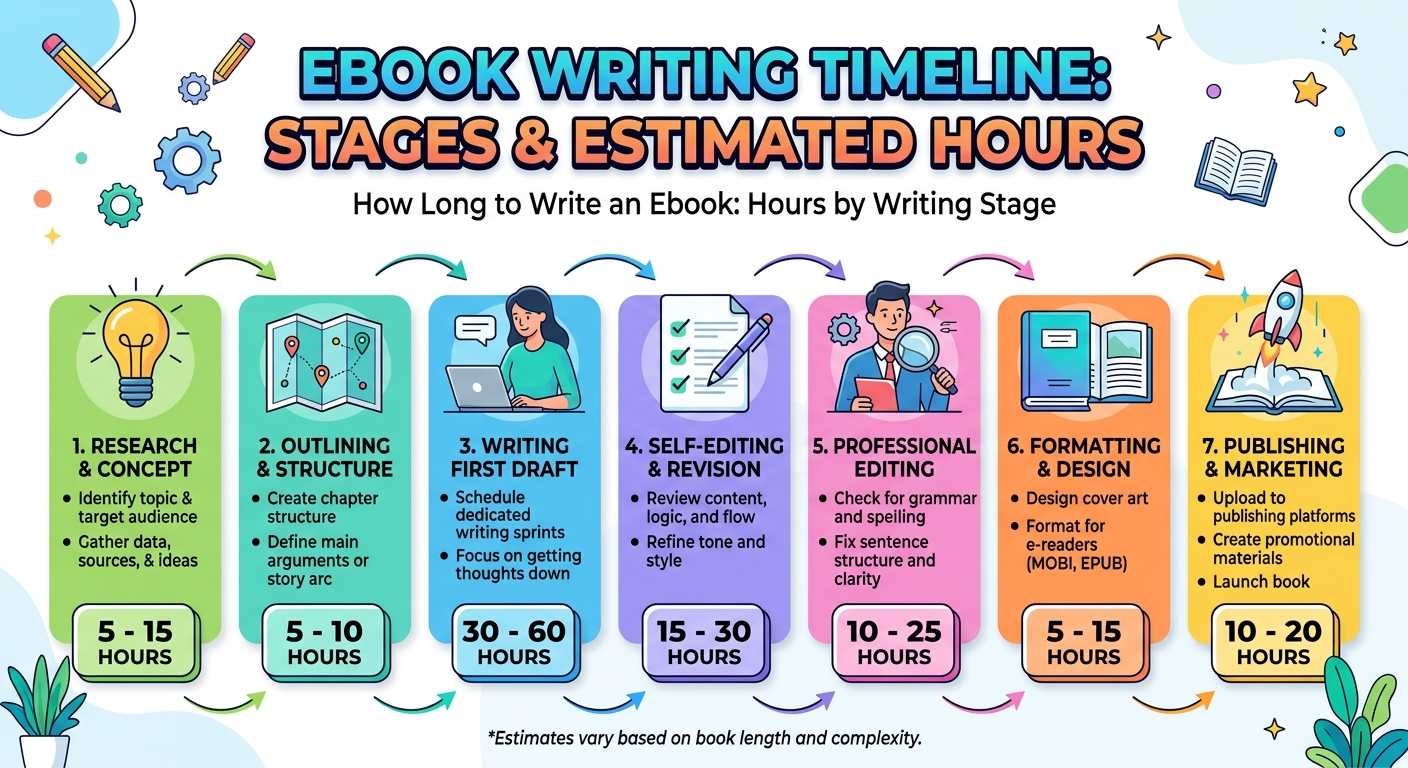
Writing an ebook yourself typically takes 120 to 180 hours of total effort, or about 8 to 16 weeks at 10 to 15 hours a week. That includes 8 to 15 hours for outlining and research, 80 to 100 hours for a first draft of 40,000 to 50,000 words, 40 to 60 hours for self-editing and revision, and 10 to 20 hours for formatting, proofreading, and cover preparation. Writing speed varies widely: most people draft at 250 to 500 words per hour, while experienced authors can reach 750 to 1,000 words per hour, according to productivity figures cited by authors like
Brandon Sanderson. So the answer to how long to write an ebook is a range shaped by word count and pace, not a single number.
The Ebook Writing Timeline, Stage by Stage
Knowing how long to write an ebook starts with seeing where the hours go, because each stage eats a different share of the clock, and skipping one usually just pushes the hours into another stage later. This table puts the stages side by side:
| Stage |
Typical hours |
Share of total |
| Outlining and research |
8 to 15 |
about 5 to 10% |
| First draft (40,000 to 50,000 words) |
80 to 100 |
about 50 to 60% |
| Self-editing and revision |
40 to 60 |
about 25 to 30% |
| Formatting, proofreading, cover prep |
10 to 20 |
about 8 to 12% |
Outlining and Research: 8 to 15 Hours
A tight chapter-by-chapter outline is what separates a 120-hour ebook from a 300-hour one. Spend this stage mapping chapters in a tool like Notion or Google Docs, confirming your core argument, and gathering the data, quotes, or case studies you’ll reference later.

Writing the First Draft: 80 to 100 Hours
This stage consumes over half the total timeline. A 45,000-word manuscript at an average pace of 400 words per hour needs roughly 112 hours of drafting alone, even before edits. Typing speed is not the limit:
Ratatype’s typing-test data puts the average typist at roughly 35 to 40 words per minute, yet thinking, structuring, and rewriting hold real drafting speed to a few hundred words an hour. Many business authors use Scrivener, Google Docs, or a dictation app like Otter.ai to keep momentum, and treat
finishing the manuscript as a scheduled sprint rather than an open-ended goal. If you stall mid-draft, these tactics for
beating writer’s block on a nonfiction book can save days.

Self-Editing and Revision: 40 to 60 Hours
Revision is where most first-time authors underestimate how long to write an ebook, since a full structural pass, a line edit, and a proofread each take separate rounds. Tools like Grammarly and ProWritingAid catch mechanical errors, but they don’t fix pacing or weak arguments, which still takes focused human review.
Formatting, Proofreading, and Cover Design: 10 to 20 Hours
Converting a manuscript into a clean EPUB or MOBI file, choosing between
Amazon KDP and IngramSpark for distribution, and commissioning a cover typically adds another two to three weeks if outsourced, or 10 to 20 hours if handled solo.
A Worked Example: Turning Hours Into a Launch Date
For a 45,000-word book, how long to write an ebook at a typical pace comes to near 190 hours and about 16 weeks. This example assumes 400 words per hour for drafting, a 12-hour outline stage, 50 hours of editing, 15 hours of formatting and cover prep, and 12 hours of work per week:
- Outlining and research: 12 hours.
- Drafting: 45,000 ÷ 400 = about 112 hours.
- Editing and revision: 50 hours.
- Formatting, proofreading, cover prep: 15 hours.
- Total: 12 + 112 + 50 + 15 = 189 hours, and 189 ÷ 12 = about 16 weeks.
Faster drafters (600 words per hour) cut the draft to 75 hours and the total to about 150 hours, or 13 weeks at the same weekly pace. Shorter formats scale down too: a 10,000-word lead magnet needs about 25 hours of drafting at 400 words per hour. If that is closer to your goal, compare a
short lead magnet ebook against a full-length book before committing.
How Long Should an Ebook Be?
Most nonfiction ebooks run 10,000 to 50,000 words, and the right length depends on the job the ebook does. Lead magnets sit at the short end, while authority-building guides sit nearer 40,000 words and above. Amazon KDP does not publish a firm minimum word count for ebooks in its
help center, so length is a reader-value decision rather than a rule. Every extra 10,000 words adds about 25 hours of drafting at 400 words per hour, plus matching editing time.
Common Delays That Stretch the Timeline
Four habits push the real answer to how long to write an ebook from 120 hours toward 300 or more for many first-time authors: writing without an outline, editing while drafting instead of after, disappearing for weeks between sessions, and skipping outside feedback until the manuscript feels “finished.” Each one adds rework rather than progress, which is exactly the kind of drift a locked outline and a fixed editing schedule are built to prevent.
Why This Timeline Matters for Your Business
For entrepreneurs and marketing teams, an ebook is a lead magnet, a sales asset, or the anchor of a content campaign. Knowing how long to write an ebook lets you back-plan a launch: build the webinar, email sequence, or landing page around a realistic finish date instead of an optimistic one. A 12-week timeline built on 120 honest hours is far more useful to a marketing calendar than a “two weekends” estimate that quietly stretches into three months. Treat the hours above as a budget line, not a suggestion, and block calendar time the same way you’d block time for a product launch.
Practical Ways to Shorten How Long to Write an Ebook
Most of the delays above are fixable, and fixing them can cut the total by 30 to 50 percent:
- Outline every chapter before writing a single paragraph of draft text.
- Set a fixed daily word-count sprint (500 to 1,000 words) instead of open-ended sessions.
- Batch all research before drafting, not during it.
- Separate drafting and editing into different days entirely.
- Get one round of outside feedback before your final proofread.
Should You Write It Yourself or Hire a Professional?
Writing it yourself is cheaper but slower; hiring a professional is faster but costs more, and your deadline and bandwidth decide which fits. A dedicated
ghostwriter typically works on your manuscript for several hours a day rather than the handful of hours a business owner can spare each week, which is why agencies compress months of solo effort into a matter of weeks. If your launch date is fixed, comparing your own timeline against options to
hire an ebook writer is worth doing before you commit 150-plus hours yourself, and this guide to
hiring an ebook writer covers what to look for.
Frequently Asked Questions
Can you write an ebook in a weekend?
A short ebook of 5,000 to 10,000 words can be drafted in a weekend, but a full nonfiction ebook cannot. At 400 words per hour, 10,000 words is 25 hours of drafting, before any editing or formatting.
How many hours a week should I plan for?
Plan for 10 to 15 hours a week. At 12 hours a week, a 190-hour project finishes in about 16 weeks; at 6 hours a week it takes about 32.
What is the slowest stage?
Drafting is the longest stage at 80 to 100 hours or more, but editing is the one most authors underestimate, because structure, line edits, and proofreading are separate passes.
Does AI change how long to write an ebook?
Dictation and AI drafting tools can speed up the first draft, but the outline, fact-checking, and revision still need your judgment, so expect savings mainly in drafting hours.
Final Takeaway
Now that you know how long to write an ebook actually takes, 120 to 180 hours across outlining, drafting, editing, and formatting, you can set a launch date based on real hours instead of an arbitrary guess, and decide with confidence whether to write it solo or bring in help.